
Knee Pain: 3 Common Muscle Patterns & What Helps

Updated: 2 days ago
Knee pain from muscle imbalance? Sydney acupuncturist Gavin Martin-Rentz explains 3 common patterns, what you can do at home and how acupuncture helps.
Lately I've had an influx of people coming into the clinic with chronic knee pain, so I put together a video on the patterns I see most. The same three patterns come up again and again.
The three most common muscular knee pain patterns I see are pain below the kneecap, pain on the outside of the knee and pain on the inside of the knee. Each is usually linked to tight or imbalanced muscles in the thigh and hip, which gives me a clear place to start when assessing. Below I'll go through each one, what you can do at home, and how I approach them with acupuncture.
These aren't the only causes of knee pain. There are many reasons your knee could be hurting, and ideally you'd come in for a proper assessment. But short of that, here are some tips for working with these common patterns.
Why do I look above and below the knee?
With any injury I assess the joints above and below, because the knee often takes the strain from problems elsewhere. For the knee that means checking how stable your ankle is and how stable your hip is, as well as the muscles of the thigh.
The research backs up looking at the hip. A 2015 Cochrane review by van der Heijden and colleagues pooled 31 trials with 1,690 people with patellofemoral pain (pain around the front of the knee). Exercise reduced pain and improved function compared with control, and adding hip exercises to knee exercises reduced pain in the short term more than knee exercises alone. The authors rated the quality of the evidence very low, mainly because of small studies and design flaws, so the findings are consistent but uncertain.
1. Pain below the kneecap

Pain directly below the kneecap is usually an irritated patellar tendon, driven by tension in the quad muscles, especially the rectus femoris. This might be called "sub-patella pain", "patellofemoral syndrome", "runner's knee", "patella tendonitis" or "patella tendinopathy". You might feel it going up and down stairs, coming on during or after running, or as a constant ache.
All four quad muscles are large, powerful muscles that attach into the same tendon below the kneecap. When there's an imbalance in the forces there, it can cause issues, especially when you start to increase the load with running. The rectus femoris runs along the middle of your thigh and is the only quad that crosses the hip as well as the knee. The hip flexors, the group of muscles that lift the hip, are also involved.
In the clinic I look for tight bands through the rectus femoris and hip flexors, and balance and support the rest of the quads.
What to do at home: foam roll the front of your thigh. Stay on areas that feel tight and restricted, and breathe into them. You can also stretch the area with the classic quad stretch, being careful not to stretch where there's pain.
2. Pain on the outside of the knee
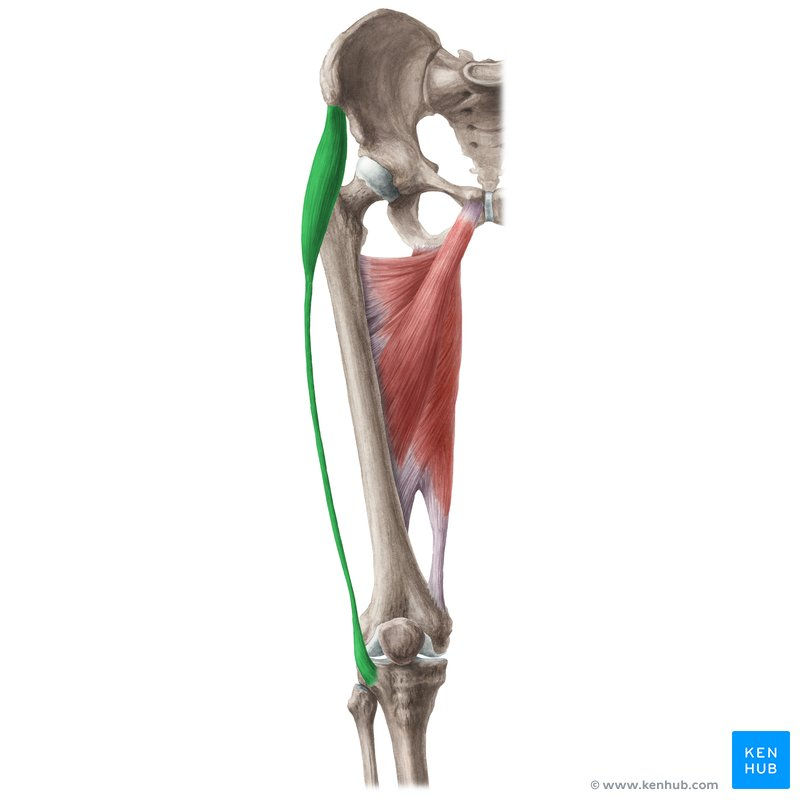

Pain on the outside of the knee is usually called iliotibial band (ITB) syndrome, and the real drivers are often the TFL and the glutes, not the band itself. This is another common injury for runners, and it might be called "lateral knee pain".
The common mistake is to focus on rolling out the ITB. The ITB is a band of fascia (connective tissue), not a muscle, so it doesn't contract. The tension in it comes from the tensor fasciae latae (TFL), a hip flexor right around where your pockets are, and the gluteus maximus. The outside quad muscle, the vastus lateralis, is also involved.
In the clinic, the TFL and glutes are the main areas I target, along with balancing the quads to take the pressure off. I may also check the outside hamstring at the back of the thigh, which can contribute.
What to do at home: focus your attention up around the hip with a tennis ball, staying on the spots that are tender and sinking into them. You can still roll down the outside of the thigh, but spend more time at the hip and glutes.
3. Pain on the inside of the knee
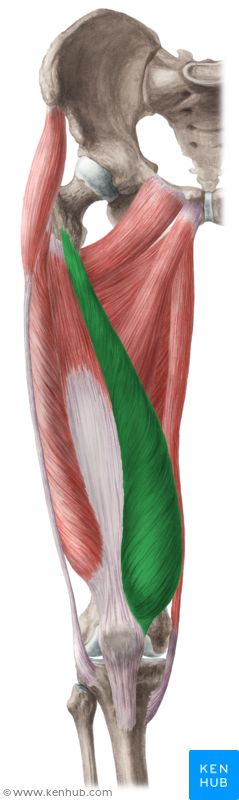


Pain on the inside of the knee can come from several structures, so I check the inside quad (vastus medialis) and the adductors first. It might be called "medial knee pain" or diagnosed as "patellofemoral syndrome", and it can also be pes anserine bursitis, or come from other structures around the inside of the knee.
The vastus medialis is the inside quad, sometimes called the "teardrop" muscle. The adductors run along the inside of the thigh. With pes anserine bursitis, the pain is typically just below the knee on the inside of the shin bone, and I also work on the sartorius (a hip flexor), the gracilis (an adductor) and the semitendinosus (a hamstring).
One thing to watch for: if there's any weakness in the knee, or it feels like it buckles or gives out, get it checked to make sure there isn't a joint component. That's totally workable too, but we want to tell the difference.
What to do at home: foam roll the inside of your thigh. It can take a little experimenting to find the right angle on the floor. Then look at the glutes and hip, because glute and hip stability are part of the picture for the knee too.
How do I foam roll for knee pain safely?
Find the tight spots, breathe into them and don't overdo it. Foam rolling is going to be sore, but if you're holding your breath and tensing your whole body, you're using too much pressure. Aim for a point where you can breathe and relax into the spot.
Stay on tight, restricted areas so they can release.
Don't stay on one spot longer than about a minute before moving on, because you don't want to over-fatigue the muscle.
If you're actively working on a problem, don't foam roll every day. Give it a day or two between sessions to allow for recovery.
Try it for a couple of weeks and see how you go. If that's all you need, that's fantastic.
How do I approach knee pain with acupuncture?
In my approach, acupuncture for knee pain targets the muscles driving the pattern, along with the hip and ankle. Depending on the pattern, that could be the quads, TFL and glutes, adductors or hamstrings, using trigger point acupuncture, motor point acupuncture and distal points. For more on how this works, see what a trigger point is.
What does the research say? A 2017 systematic review and meta-analysis in Acupuncture in Medicine pooled trials of acupuncture for chronic knee pain. It found acupuncture was associated with reduced pain at 12 weeks, and the authors called for larger trials to confirm this.
That's what the research reports, and study results can't predict how you'll respond.
I usually suggest at least 6 sessions to see how you respond, then plan from there. For a chronic pattern, 12 can be a more realistic starting place, with regular reviews along the way, and continuing is always your decision. Read more on how long acupuncture takes to work and how often to come.
FAQs: Knee Pain
Q: What causes knee pain from muscle imbalance?
A: Tight or imbalanced muscles in the thigh and hip can pull unevenly on the knee. The common patterns I see are quad tension behind pain below the kneecap, TFL and glute tension behind pain on the outside, and inside quad and adductor tension behind pain on the inside.
Q: Should I foam roll my ITB for outside knee pain?
A: I suggest focusing on the hip. The ITB is a band of fascia that doesn't contract, and the tension comes from the TFL and glutes. A tennis ball at the hip, plus rolling down the outside of the thigh, is the approach I suggest.
Q: How long should I foam roll a sore spot?
A: No longer than about a minute before moving on, so you don't over-fatigue the muscle. Use enough pressure that you can still breathe and relax into it.
Q: Why do you check my hip and ankle for knee pain?
A: With any injury I assess the joints above and below, because instability at the hip or ankle can show up as knee pain. A Cochrane review found adding hip exercises to knee exercises reduced short-term pain more than knee exercises alone, though the evidence quality was very low.
Q: How many acupuncture sessions are needed for knee pain?
A: I usually suggest at least 6 sessions to see how you respond, then plan from there. For a chronic pattern, 12 can be a more realistic starting place, with regular reviews along the way, and continuing is always your decision.
Q: When should I get my knee checked?
A: If your knee feels weak, buckles or gives out, have it assessed to make sure there isn't a joint component. I'd also recommend an assessment if self-care isn't helping.
Q: What happens at the first appointment?
A: An initial session involves a consult, assessments and treatment. I explain everything you need to know and what to expect, and we come up with a plan to suit your goals.
Ready to look at your knee pain?
If some simple self-treatment is all you need, that's fantastic. If you're looking for a more comprehensive and systematic approach to your knee pain, you're welcome to come and see me.
If you'd like to try acupuncture for knee pain in Sydney's eastern suburbs, consider Acupuncture Grove in Bondi Junction. You can book online here or reach out with any questions here.
Also read:
Gavin Martin-Rentz is an AHPRA-registered acupuncturist and Chinese medicine practitioner at Acupuncture Grove, Bondi Junction, Sydney, with over 10 years in practice.
Acupuncture Grove services Bondi Junction, Bondi Beach, Coogee, Clovelly, Bronte, Waverley, Randwick, Maroubra, Double Bay, Watsons Bay, Vaucluse and surrounding Sydney suburbs.


Comments